The Hidden Divide Between Jungian Psychology and Biblical Christianity
This matrix framework categorizes your relationship with your hidden self across two axes: Knowledge (Knowing vs. Not Knowing) and Acceptance (Accepting vs. Not Accepting).

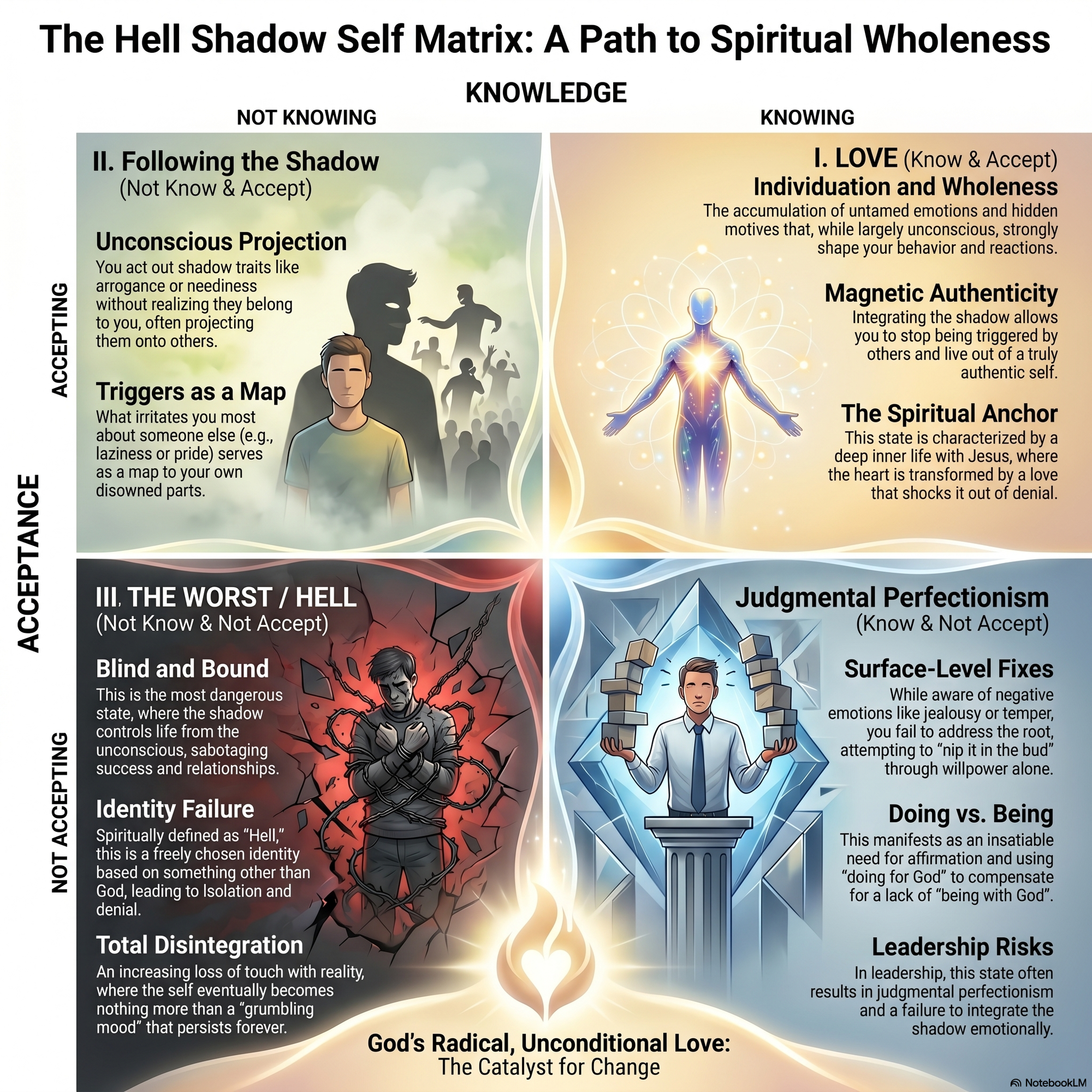
The "Hell Shadow Self" framework categorizes your relationship with your hidden self across two axes: Knowledge (Knowing vs. Not Knowing) and Acceptance (Accepting vs. Not Accepting). The shadow self is the accumulation of untamed emotions and hidden motives that, while largely unconscious, strongly shape your behavior.
Here is the clarification of the four quadrants as requested:
The Best: Quadrant I (Know & Accept) – "LOVE"
This quadrant represents the ultimate goal of spiritual and emotional health: knowing yourself and accepting your shadow self .
- Wholeness: This leads to individuation, where you own your hidden parts and they become your "greatest strengths." Jungians call this "turning lead into gold."
- Authenticity: By integrating these parts, you stop being triggered by others and become "magnetically authentic."
- Spiritual Anchor: Achieving this requires a "deep inner life with Jesus" and a heart transformed by radical, unconditional love, which is the only thing that can shock a heart out of its natural state of denial.
The Worst: Quadrant III (Not Know & Not Accept)
This is the most dangerous state, where you are unaware of your self and remain "blind + bound to the worst of the shadow self."
- Unconscious Control: Because you don't know these parts exist, your shadow controls your life from the unconscious, sabotaging success and relationships.
- Identity Failure: Spiritually, this aligns with the definition of "Hell": a freely chosen identity based on something other than God.
- Disintegration: This state leads to disintegration, isolation, and denial 8. You become increasingly out of touch with reality, eventually becoming nothing but a "grumbling mood" that goes on forever.
Quadrant II (Not Know & Accept)
In this state, you are unaware of self but are "following the shadow self."
- Projection: You act out your shadow traits (like arrogance or neediness) without realizing they belong to you.
- Triggers: You project these "disowned parts" onto others. What irritates you most about someone else—their laziness or pride—is actually a "map to your shadow." You are "following" these traits because they dictate your reactions to the world without your conscious consent.
Quadrant IV (Know & Not Accept)
Here, you are aware of self and your spiritual needs, but you remain "unaware of or inattentive to negative, inappropriate emotions."
- The "Nip it in the Bud" Problem: You may notice your "bad temper or jealousy" getting worse over time, but you fail to address the root.
- Surface-Level Fixes: This often manifests in leadership as judgmental perfectionism or an "insatiable need for affirmation." You know there is a gap, but because you haven't accepted and integrated the shadow, you use your "doing for God" to compensate for the lack of "being with God."
Summary of the Path
The transition from the "worst" to the "best" quadrant is a "formidable task" because the ego naturally resists the discomfort of shadow work. However, understanding this framework is crucial because "fear of damnation" will never change the heart; only God's costly love provides the security needed to face the shadow and find true alignment.
Who Was Carl Jung?
Carl Jung (1875–1961) was a Swiss psychiatrist and the founder of analytical psychology. He began as a colleague of Sigmund Freud but later broke away because he believed human beings were more than biological drives and suppressed desires. Jung explored dreams, symbols, myths, spirituality, personality types, and the deep structures of the human psyche.
His influence appears today in:
- Personality testing (especially MBTI-style systems)
- Counseling and psychotherapy
- Spirituality and self-help movements
- Literature, film, and storytelling
- Discussions of archetypes and the “shadow self”
Core Theories of Carl Jung
1. The Collective Unconscious
Jung believed every human shares a deep psychological layer beneath personal experience.
He called this the collective unconscious — a reservoir of inherited symbols, instincts, and patterns shared across humanity.
According to Jung:
- Myths from different cultures resemble one another because humans share universal inner patterns.
- Religious symbols emerge from this shared unconscious.
- Dreams reveal these deeper realities.
Biblical Comparison
Similarity:
Biblical Christianity also teaches that humans share a common human nature descended from Adam.
Difference:
Christianity grounds humanity’s shared condition in:
- Creation by God
- The Fall into sin
- Spiritual realities revealed by God
Jung grounded it in psychological inheritance and symbolic structures rather than divine revelation.
Christianity says truth comes primarily from God’s revelation. Jung often treated religious imagery as expressions of the psyche.
2. Archetypes
Jung taught that universal symbolic patterns called archetypes appear repeatedly across cultures and stories.
Examples include:
- The Hero
- The Wise Old Man
- The Mother
- The Child
- The Trickster
- The Shadow
These archetypes shape behavior, dreams, stories, and identity.
Biblical Comparison
Similarity:
The Bible contains recurring human patterns:
- Heroic deliverers
- Wise prophets
- Betrayers
- Sacrificial figures
- Fathers, mothers, kings, shepherds
These resonate deeply because humans are created in God’s image and share common struggles.
Difference:
Christianity views biblical figures as real people within God’s redemptive history, not merely symbolic expressions of universal psychology.
For Jung:
- Christ could be interpreted psychologically as an archetype of the “Self.”
For Christianity:
- Jesus Christ is not merely symbolic.
- He is the incarnate Son of God, crucified and resurrected in history.
This is a major dividing line.
3. The Shadow
One of Jung’s most famous ideas is the shadow.
The shadow represents:
- Repressed desires
- Hidden sins
- Denied emotions
- Dark impulses
- Parts of ourselves we refuse to face
Jung believed healing requires acknowledging and integrating the shadow rather than pretending it does not exist.
Biblical Comparison
Similarity:
Christianity strongly agrees that humans often hide sin and deceive themselves.
Scripture repeatedly calls believers to:
- Confession
- Repentance
- Bringing darkness into light
For example:
“If we walk in the light… the blood of Jesus cleanses us.” (1 John 1:7)
Difference:
Jung emphasized integration of the shadow into the self.
Biblical Christianity emphasizes:
- Repentance
- Crucifixion of sinful desires
- Sanctification through the Holy Spirit
Christianity does not merely seek harmony with sinful impulses but transformation through Christ.
4. Individuation
Jung believed the goal of life is individuation by becoming a whole, integrated self.
This involves:
- Reconciling conscious and unconscious parts
- Integrating shadow aspects
- Discovering authentic identity
- Moving toward inner wholeness
Biblical Comparison
Similarity:
Christianity also speaks of transformation and maturity.
Believers are called to:
- Grow spiritually
- Become whole in Christ
- Be transformed from the inside out because God is in them. They work out what God has worked in by cultivating the characteristics of a the fruit of the Spirit through surrender, submitting to obey the Creator to become the person God created them to be.
Difference:
Jung’s process is fundamentally self-centered psychologically.
Biblical Christianity is God-centered relationally.
Jung’s question:
“How do I become my true self?”
Christianity’s question:
“How do I die to self and live in Christ?”
Jesus taught:
“Whoever loses his life for My sake will find it.”
That is profoundly different from modern self-actualization frameworks.
5. Dreams and Symbols
Jung believed dreams carry deep psychological and spiritual meaning.
He encouraged analyzing:
- Symbols
- Emotions
- Recurring dream themes
- Mythological imagery
Biblical Comparison
Similarity:
The Bible contains many God-given dreams:
- Joseph
- Daniel
- Joseph, husband of Mary
- Pharaoh’s dreams interpreted by Joseph
God can communicate through dreams.
Difference:
Christianity warns against elevating subjective experiences above Scripture. Jung often approached dreams as pathways to inner truth regardless of biblical authority. Biblical Christianity tests spiritual experiences against God’s revealed Word.
Major Areas of Tension Between Jung and Christianity
1. Source of Truth
Jung - Truth emerges partly from:
- Inner exploration
- Symbols
- Dreams
- Myths
- Psychological experience
Christianity - Truth is a person who is ultimately revealed by God through:
- Scripture
- Christ
- The Holy Spirit
The heart is not automatically trustworthy.
2. View of Sin
Jung - Sinful impulses are often psychological fragments needing integration.
Christianity - Sin is rebellion against God requiring:
- Repentance
- Forgiveness
- Redemption through Christ
3. View of Jesus
Jung - Jesus can function symbolically as an archetype of wholeness.
Christianity - Jesus is the literal Son of God and Savior of the world.
This difference changes everything.
4. Salvation
Jung - Healing comes through psychological integration and self-discovery.
Christianity - Salvation comes through grace by faith in Christ.
Humans cannot save themselves through inner exploration
Where Christians Sometimes Find Jung Helpful
Some Christians cautiously appreciate Jung’s insights about:
- Human brokenness
- Symbolism
- Self-deception
- Emotional wounds
- The danger of repressing sin and pain
- The need for honesty about darkness
His observations can sometimes describe real aspects of human experience.
However, many Christians remain cautious because Jung:
- Blurred lines between psychology and spirituality
- Explored occult and mystical ideas
- Treated religions comparatively rather than exclusively true
- Centered inner self-discovery more than repentance and submission to God
A Helpful Way to Think About It
Jung was often insightful diagnostically but unreliable theologically.
He recognized:
- Humans are fractured
- Symbols shape us
- Evil hides beneath the surface
- People long for meaning and transcendence
But Christianity would argue:
- The deepest human problem is sin before a holy God
- The deepest solution is reconciliation through Christ
- True transformation comes not merely through integration, but regeneration
In biblical language:
The goal is not simply becoming a more integrated self.
The goal is becoming a new creation in Christ.
That distinction matters profoundly.
 Bev Garcia